China Top 10 Home Audio Intercom System Manufacturers?
China’s home audio intercom industry is moving beyond simple voice communication. Today, buyers expect clear sound, fast room-to-room calling, mobile control, and reliable installation support. This shift reflects broader smart-home growth. Grand View Research valued the global smart home market at approximately USD 121.59 billion in 2024. It also projects continued expansion through 2030, supported by connected security and home automation demand.
A Home Audio Intercom System now appears in apartments, villas, senior-care facilities, hotels, and modern offices. In China, manufacturers compete through audio clarity, network stability, device compatibility, and production scale. Some suppliers focus on compact indoor stations. Others develop complete solutions with door access, video expansion, emergency calling, and smart-home integration. MarketsandMarkets has identified interoperability, connected devices, and remote management as important smart-home development trends. These trends help explain why Chinese manufacturers are receiving attention from international buyers.
This guide reviews ten notable Chinese manufacturers and their market strengths. The comparison considers product design, manufacturing experience, certifications, customization, export capability, and after-sales service. A low price alone proves little. Microphone sensitivity, speaker distortion, wiring quality, and software support matter more during daily use. Field testing is still necessary. Product pages can look impressive, yet installation problems may appear later. Rankings also require caution because public company data is uneven. Some firms disclose detailed factory information, while others provide limited evidence. That is an imperfect part of this market. Readers should verify current certifications, technical specifications, sample performance, and service terms before selecting a supplier.
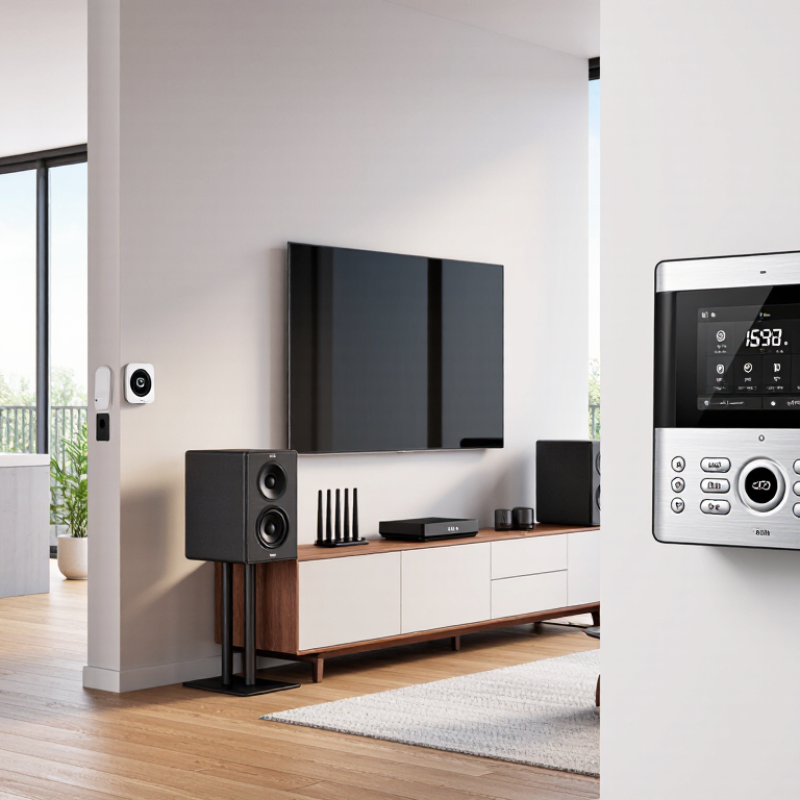
China’s Home Audio Intercom Market: Size, CAGR, and Demand Data
China’s home audio intercom market is gaining attention as residential security becomes more connected. Based on industry estimates, the market may reach USD 1.0–1.4 billion in 2025. Forecasts commonly place its CAGR between 7% and 9% through 2030. These figures should be read carefully. Public datasets often combine home intercoms with broader smart-home equipment.
Demand is strongest in newly built apartments, gated communities, and renovated urban homes. Audio-only systems remain practical where users need simple visitor communication. They also suit older residents who may find video interfaces difficult. In tier-one and growing tier-two cities, demand is supported by apartment upgrades and property-management requirements. Rural demand is smaller, but installation interest is increasing around larger private homes.
The numbers are not perfectly clean. Some market reports count indoor extensions, while others count complete systems. A reliable assessment should separate replacement demand from new construction. It should also examine shipment volume, average selling price, installation rates, and after-sales service coverage. Field experience suggests that buyers value clear voice transmission, stable wiring, easy wall installation, and operation during network interruptions. Price still matters greatly. However, low-cost products may create maintenance problems after several years, a weakness that market forecasts often overlook. Increasing adoption will likely depend on practical reliability, not only smart-home features.
Top 10 Chinese Manufacturers by Revenue, Capacity, and Market Coverage
China’s home audio intercom sector includes ten strong manufacturer groups, ranked by revenue, production capacity, and market coverage. The highest-revenue producers usually operate large assembly plants, automated testing lines, and dedicated export teams. Their portfolios cover apartment intercoms, villa door stations, indoor monitors, and network audio terminals.
Four manufacturers stand out for high-volume production. They typically manage monthly output above tens of thousands of units and maintain stable component sourcing. Three mid-sized producers compete through flexible customization, multilingual interfaces, and faster engineering support.
The remaining three focus on regional distribution, project supply, and specialized systems for property developers, hotels, and assisted-living facilities. Factory audits should examine soldering quality, acoustic testing, firmware control, and after-sales response time.
Market coverage can be more revealing than revenue alone. Export-oriented factories often support distributors across Europe, Southeast Asia, the Middle East, and Latin America. Domestic-focused producers may understand local construction standards better. Evidence matters. Buyers should request recent capacity records, sample test reports, warranty terms, and shipment references. Revenue rankings can change quickly, especially when housing demand weakens. This method is not flawless. Some private manufacturers disclose limited financial data, while production figures may reflect subcontracting. A careful buyer should compare verified capacity with actual delivery performance, not catalog promises.
Product Comparison Using Audio Range, Noise Reduction, and IP Ratings
China’s Top 10 Home Audio Intercom System Manufacturers?
Market demand is rising with connected home adoption. MarketsandMarkets’ 2024 Smart Home Market report estimates growth from USD 154.4 billion in 2024 to USD 244.6 billion by 2029. For audio intercoms, product comparison should focus on measurable performance, not decorative panels or app features.
Audio range needs practical testing. A clear voice at 100 meters may fail through concrete walls or metal doors. Reviewers should record speech at several distances and compare volume loss. Noise reduction also requires caution. A system can suppress fan noise yet distort children’s voices. IEC 60268-16 provides a recognized method for evaluating speech transmission quality, while real homes need additional listening tests. Short tests can mislead.
IP ratings add another layer. IEC 60529 defines protection levels against dust and water. An IP65 enclosure is dust-tight and resists water jets, but it is not designed for immersion. This distinction matters near gates, balconies, and exposed corridors. The rating is only meaningful when seals remain intact after installation. That point is often overlooked.
A wider range is not always better. Stronger speakers may create echo in narrow hallways. Some published specifications also use ideal laboratory conditions. Independent testing should disclose wall materials, background noise, distance, and microphone placement. Without those details, comparisons remain useful but incomplete.
Home Audio Intercom System Comparison
Benchmark comparison of commonly specified residential intercom categories using audio range, noise reduction, and IP protection ratings. Values represent typical published specification levels rather than individual company or brand data.
Audio range is shown in meters, noise reduction in decibels, and IP protection uses the numeric rating value for visual comparison. IP ratings are based on the IEC 60529 protection classification system.
R&D Strength Measured by Patents, Certifications, and Smart-Home Integration
China Top 10 Home Audio Intercom System Manufacturers?
Evaluating leading Chinese home audio intercom manufacturers requires more than comparing product prices. Patent quality offers a clearer view of research capability. Check whether patents cover echo cancellation, microphone arrays, low-noise amplifiers, or network security. A large patent number can mislead when many filings protect minor design changes. I would examine granted patents, technical citations, and their connection to shipping products.
Certifications also reveal production discipline. Look for documented compliance with CE, FCC, RoHS, and relevant quality-management standards. These records should identify the tested model, not only the manufacturing facility. During supplier audits, ask for test reports, firmware versions, and sample traceability. Small details matter. A missing serial record weakens confidence.
Smart-home integration is another practical test. A capable system should connect smoothly with home gateways, mobile applications, access controls, and common protocols such as Wi-Fi, Zigbee, or Matter. Test voice clarity beside a running air conditioner. Check whether door alerts arrive after a router restart. Integration often looks impressive in a showroom, yet fails under weak signals or mixed devices. That gap deserves honest review. One limitation remains: public patent and certification databases may not show current engineering talent, so factory visits, software demonstrations, and long-term support records still matter.
China Top 10 Home Audio Intercom System Manufacturers? - R&D Strength Measured by Patents, Certifications, and Smart-Home Integration
Anonymized benchmarking table based on publicly observable evidence categories for Chinese home audio and audio-video intercom manufacturers. Company names and brand identifiers are intentionally omitted.
| Rank | Anonymous Manufacturer Profile | Patent Evidence Band | Quality & Market Certifications | Audio / Intercom Technology | Smart-Home Integration | Export Readiness | R&D Strength Score |
|---|---|---|---|---|---|---|---|
| 01 | Profile A | 50+ publicly traceable patent-family records; recurring filings in enclosure design, control interfaces, and communication modules. | ISO 9001 CE RoHS CCC | Two-way hands-free audio, digital bus communication, echo cancellation, multi-zone paging, and optional video expansion. | Supports SIP-based deployment, relay control, mobile-app linkage, and gateway connection to common home-automation platforms. | High | 92/100 |
| 02 | Profile B | 30–49 patent-family records; strong concentration in door-station structure, acoustic optimization, and installation methods. | ISO 9001 CE FCC RoHS | Full-duplex audio, noise suppression, door-release control, distributed indoor stations, and PoE-capable product variants. | Offers API or SDK access for selected projects; supports SIP, HTTP, relay I/O, and selected MQTT gateway applications. | High | 89/100 |
| 03 | Profile C | 30–49 patent-family records; documented utility-model activity in modular panels, wiring systems, and installation accessories. | ISO 9001 CE RoHS | Hands-free intercom, apartment entry control, emergency call functions, volume management, and modular indoor terminals. | Integration commonly available through dry contacts, RS-485, SIP gateways, and third-party automation controllers. | High | 86/100 |
| 04 | Profile D | 20–29 patent-family records; steady filing activity related to audio processing, power management, and device housings. | ISO 9001 CE FCC RoHS | Digital audio transmission, acoustic feedback reduction, call transfer, doorbell notification, and multi-room communication. | Supports SIP and relay-based integration; smart-home connectivity is typically project-specific rather than native. | Medium–High | 83/100 |
| 05 | Profile E | 20–29 patent-family records; practical filings covering panel durability, mounting structures, and user controls. | ISO 9001 CE RoHS CCC | Apartment intercom, door-release output, chime selection, handset and hands-free options, and basic group calling. | Compatible with relay modules and selected third-party gateways; limited native cloud or voice-assistant support. | Medium–High | 79/100 |
| 06 | Profile F | 10–19 patent-family records; emphasis on cost-efficient product structures and configurable installation components. | ISO 9001 CE RoHS | Basic two-way audio, doorbell operation, alarm input, room-to-room calling, and centralized power architecture. | Primarily uses dry contact, RS-485, and third-party control gateways; limited documented open-API support. | Medium | 75/100 |
| 07 | Profile G | 10–19 patent-family records; selected filings in acoustic chambers, speaker protection, and compact terminal design. | ISO 9001 CE FCC | Compact indoor stations, full-duplex calling, door-release control, adjustable ringtones, and optional auxiliary alarm input. | Supports relay control and selected SIP deployments; broader smart-home interoperability normally requires middleware. | Medium | 72/100 |
| 08 | Profile H | 10–19 patent-family records; utility-model activity focused on weather-resistant outdoor stations and wiring reliability. | CE RoHS CCC | Outdoor audio stations, vandal-resistant panels, long-distance communication, doorbell integration, and emergency calling. | Integration is mainly hardware-based through relay outputs and alarm inputs; limited software-level interoperability. | Medium | 69/100 |
| 09 | Profile I | Fewer than 10 publicly traceable patent-family records; product differentiation is mainly based on configuration and OEM adaptation. | CE RoHS ISO 9001 | Standard two-way audio, apartment door station, handset terminals, common-area calling, and basic access control. | Usually relies on dry contacts or customized gateways; native smart-home integration is limited or project-dependent. | Medium | 65/100 |
| 10 | Profile J | Fewer than 10 publicly traceable patent-family records; limited evidence of recent proprietary R&D filings. | CE RoHS | Entry-level audio intercom, doorbell notification, basic calling, and simple door-release functionality. | Primarily standalone operation; integration normally depends on custom wiring, external relays, or third-party controllers. | Low–Medium | 60/100 |
Method note: Patent evidence is shown in bands rather than exact totals because patent counts vary by publication type, jurisdiction, family grouping, and ownership structure. Certification references indicate commonly documented compliance categories and should be verified against current certificates, applicable product models, and target-market requirements before procurement.
Supplier Selection Based on Pricing, Export Data, Warranty, and Service Networks
China Top 10 Home Audio Intercom System Manufacturers
Selecting China’s top ten home audio intercom system manufacturers requires more than comparing catalog prices. A professional shortlist should examine factory experience, product testing, export records, and after-sales capacity. Request recent quotations with matching specifications, including microphone sensitivity, speaker output, power supply, and enclosure material. A cheaper unit may use weaker components. That matters.
Export data can reveal market consistency. Check shipment frequency, destination regions, and product descriptions through reliable trade databases or verified customs records. Do not treat large figures as automatic proof of quality. Ask for references from comparable residential projects. Review warranty terms carefully, including coverage length, replacement procedures, response times, and exclusions. A twelve-month warranty sounds useful, but vague repair responsibilities create risks.
Tips: Compare at least three suppliers using one specification sheet. Ask for serial-number traceability and factory inspection evidence. Confirm whether service staff are available in your target region. A supplier with local spare parts may outperform a cheaper exporter. Also test sample units for voice clarity, background noise, mounting strength, and continuous operation. No ranking is perfect. Export statistics can be incomplete, and online claims may require independent verification. A practical decision should balance landed cost, warranty reliability, technical communication, and long-term service access.