Top 10 Water Treatment Equipment Types for Global Buyers
Reliable water treatment depends on more than a single machine. It relies on equipment matched to the water source, treatment goals, and operating conditions. The need is substantial: the WHO/UNICEF Joint Monitoring Programme reported that 2.2 billion people lacked safely managed drinking water services in 2022. The UN World Water Development Report 2024 also highlights growing pressure on water systems from population growth, pollution, and climate variability. These figures make sound equipment choices a practical priority.
For global buyers, “water treatment equipment” covers a broad toolkit. Intake screens remove leaves and debris; pumps move water between process stages; dosing systems add treatment chemicals; clarifiers settle suspended solids. Media filters, membrane systems, ultraviolet units, and disinfection equipment address different contaminants and process needs. No single type fits every plant. A municipal facility handling river water may need different stages from a factory reusing process water. Site conditions matter.
This guide examines ten common equipment types and the jobs they perform. It also considers practical questions buyers should ask, including throughput, energy use, maintenance access, spare-parts availability, and operator training. Product specifications deserve careful checking. A high-rated capacity on paper does not guarantee reliable performance in the field. That assumption deserves a second look. Equipment selection is only one part of safe, dependable treatment, but it can shape operating costs and service continuity for years.
Water Treatment Equipment: Core Functions and System Boundaries
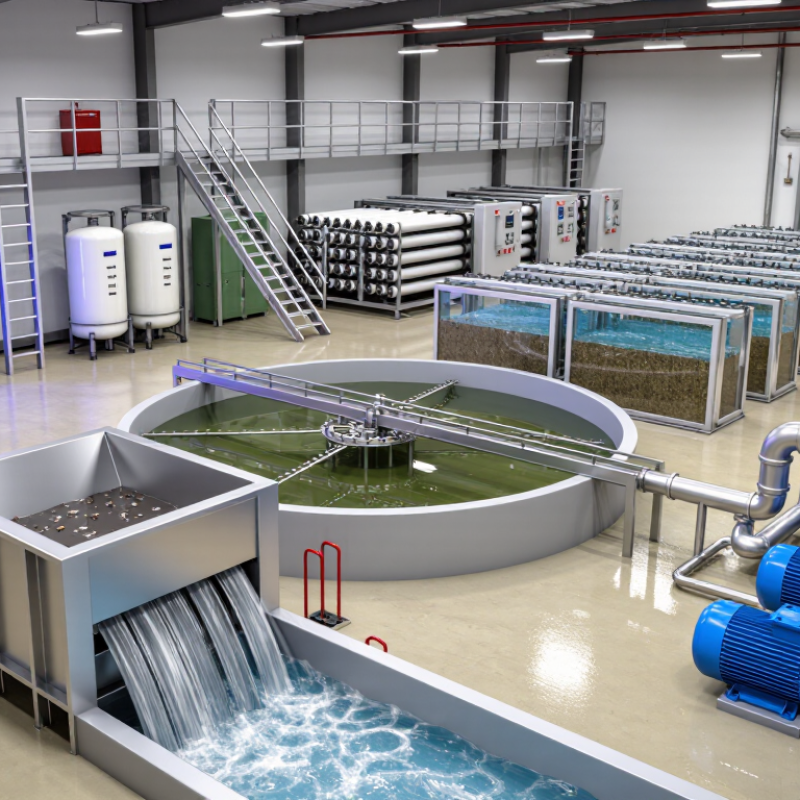
Water treatment equipment is best understood by the job it performs, not its nameplate. At the inlet, screens and strainers catch grit, fibers, and other visible debris. Media filters reduce suspended particles; membranes separate finer material under controlled pressure. Disinfection units address microorganisms, while dosing pumps adjust specific water chemistry. Different jobs. None works alone.
A practical system boundary starts at the raw-water connection and ends at the treated-water handoff. Inside it are vessels, pumps, valves, instruments, controls, and the pipework linking them. Outside it may sit intake storage, distribution networks, sludge handling, or the building’s power supply. Those interfaces matter: a filter can perform well, yet clog quickly if upstream loading changes. Operators should check flow, pressure drop, sampling points, and reject or backwash routes during design review. A conductivity reading can reveal a membrane trend before output quality shifts. Real sites rarely match drawings perfectly. That gap deserves attention.
The Ten Main Types of Water Treatment Equipment
A treatment train may include ten core equipment types: screening, coagulation and flocculation, sedimentation, media filtration, softening, activated-carbon adsorption, ion exchange, ultrafiltration, reverse osmosis, and disinfection. Each targets different contaminants, from grit and suspended solids to dissolved salts and microbes. The WHO/UNICEF Joint Monitoring Programme reported that 2.2 billion people lacked safely managed drinking water in 2022. That figure underscores the need for systems designed around local water quality, not just equipment lists. No single train fits every source; projects still sometimes choose units before collecting enough samples.
Tips: Test raw water for turbidity, hardness, salinity, and microbial indicators before sizing equipment. Check peak flow, not only daily averages. For example, a membrane system may reduce dissolved salts, but it also creates a reject stream that needs responsible handling. Disinfection with ultraviolet light, chlorine, or ozone depends on operating conditions and water chemistry. Maintenance matters too: a clogged filter can raise pressure and weaken downstream performance. These details are easy to underestimate.
How Equipment Types Work Across Treatment Stages
Water treatment equipment performs best as a connected train, not as a list of machines. Screens and grit chambers remove rags, leaves, and sand before they damage pumps. Coagulators then mix chemicals rapidly, forming particles that settle in clarifiers. Multimedia filters catch finer solids, while activated carbon can reduce taste, odor, and some organic compounds. Small details matter. Poor flow distribution can leave one filter overloaded while another sits underused.
The next stage depends on the water’s chemistry and the required output. Membranes, including reverse osmosis, separate dissolved salts; ultraviolet systems inactivate microbes, while chlorine can provide a disinfectant residual in distribution. These units are not interchangeable. The WHO/UNICEF Joint Monitoring Programme reported that 2.2 billion people lacked safely managed drinking water in 2022, underscoring the need for reliable, maintainable treatment trains. For wastewater projects, UNESCO’s 2017 World Water Development Report estimated that over 80% of wastewater worldwide was discharged without adequate treatment. That estimate is dated, but it highlights a persistent equipment challenge: treatment must include solids handling, not just clear-looking effluent. A tidy process diagram can still miss sludge storage, backwashing, or operator skill. Not every plant needs membranes. Sizing should follow source-water tests, seasonal variation, energy access, and the quality target.
Applications and Performance Factors by Equipment Type
Water treatment equipment should match the source water, target contaminants, and required flow—not just a supplier’s capacity figure. Screens remove leaves, fibers, and other coarse debris before pumps or downstream units are affected. Clarifiers separate settleable solids; their performance depends on particle size, flow rate, and settling time. Media filters capture finer suspended matter, but pressure loss rises as beds collect solids. Backwashing restores flow, though it uses water.
Activated carbon adsorbs many taste, odor, and organic compounds; contact time and carbon condition matter. Microfiltration and ultrafiltration membranes reduce particles and microorganisms, with fouling controlled through pretreatment and cleaning. Reverse osmosis removes dissolved salts, but feed pressure, scaling risk, and concentrate volume affect operation. Ion-exchange units target selected dissolved ions and need suitable regeneration plans. Details matter. Ultraviolet systems inactivate microorganisms when water has low enough turbidity and lamps stay clean. Ozone can oxidize some contaminants, yet requires careful dosing and contact time. Chemical dosing systems add disinfectants or coagulants; accurate pumps and regular checks help avoid underdosing or excess residuals. A tidy performance chart can mislead. In real plants, changing source water and neglected maintenance can undermine even well-sized equipment.
Key Criteria for Global Buyers Comparing Equipment
Global buyers should compare treatment equipment against the water they actually have, not a generic specification sheet. The WHO/UNICEF Joint Monitoring Programme reported that 2.2 billion people lacked safely managed drinking water in 2022. That figure signals the scale of the challenge, but it cannot select a system for a particular site. Measure the water. Test seasonal changes in turbidity, salinity, temperature, and contaminants before comparing filters, membranes, or disinfection units.
Energy use can change the economics. The International Energy Agency’s World Energy Outlook 2016 estimated that water-related services used about 4% of global electricity, with demand potentially doubling by 2040. Ask suppliers for energy use per cubic metre at the required output quality, and check the test conditions behind the number. A small pilot can reveal fouling or pressure problems that a brochure misses. Field conditions differ.
Compare total operating needs, not only purchase price: replacement media, chemicals, maintenance access, operator training, and spare-part lead times all matter. Check whether the equipment can handle the site’s flow range and whether its waste stream has a practical management route. Require documented performance limits and commissioning support. A neat spreadsheet may still miss a difficult maintenance task. I would leave room for that uncertainty.
| Equipment Type | Primary Function | Best Suited For | Key Comparison Criteria | Operating and Lifecycle Considerations |
|---|---|---|---|---|
| 1. Screens and Screening Systems | Remove larger debris and suspended solids from incoming water or wastewater to protect downstream equipment. | Raw-water intakes, sewage works, and industrial wastewater pretreatment. | Screen opening size, hydraulic capacity, peak-flow handling, allowable head loss, cleaning method, and screenings discharge arrangements. | Compare automatic cleaning requirements, wear parts, access for maintenance, and safe handling or disposal of collected screenings. |
| 2. Coagulation and Flocculation Systems | Disperse treatment chemicals and promote particle aggregation so fine particles can be removed by settling or filtration. | Surface water and wastewater with colloids or fine particles that are difficult to settle or filter directly. | Mixing intensity and control, chemical dosing accuracy, flow range, pH and alkalinity needs, and compatibility with the downstream process. | Chemical dose depends on source-water quality and should be established through testing. Assess chemical storage, dosing safety, and the additional sludge produced. |
| 3. Clarifiers and Sedimentation Tanks | Separate settleable solids from water by gravity, commonly after coagulation and flocculation. | Municipal and industrial treatment systems requiring removal of floc or other settleable particles. | Design flow and peak flow, settling characteristics, footprint, inlet and outlet design, sludge collection, and access for inspection. | Clarification does not remove dissolved salts. Performance depends on water characteristics and operating conditions; account for sludge withdrawal and disposal. |
| 4. Granular Media Filters | Remove remaining suspended particles as water passes through sand or other granular filter media. | Drinking-water and industrial-water treatment, often following clarification or another particle-removal step. | Filtration rate, media type and depth, expected filtrate quality, backwash method, backwash-water availability, and controls. | Compare backwash frequency and water use, head-loss monitoring, media replacement needs, and the handling of backwash water. |
| 5. Activated Carbon Adsorbers | Adsorb many organic compounds and help reduce taste, odor, and chlorine, depending on the carbon and water conditions. | Water containing target adsorbable organics, taste or odor compounds, or chlorine that must be removed before a sensitive process. | Target contaminants, empty-bed contact time, vessel capacity, carbon type, pressure drop, and provisions for sampling and changeout. | Carbon performance declines as adsorption sites are used. Plan for breakthrough monitoring and spent-carbon replacement or regeneration; activated carbon is not a general dissolved-salt removal process. |
| 6. Microfiltration and Ultrafiltration Systems | Use membranes to separate suspended particles and microorganisms from water; performance depends on membrane characteristics and system integrity. | Surface-water, wastewater-reuse, and pretreatment applications where particle and microbial barrier performance is required. | Membrane configuration, design flux, feed-water quality, integrity testing, cleaning strategy, recovery, and required filtrate quality. | These processes generally do not remove dissolved salts. Compare backwashing and cleaning needs, fouling control, membrane replacement, and concentrate or backwash handling. |
| 7. Reverse Osmosis Systems | Use pressure-driven membranes to reduce dissolved salts and many other dissolved constituents. | Desalination, brackish-water treatment, and applications requiring lower dissolved-solids concentrations. | Feed-water analysis, required permeate quality, recovery, operating pressure, energy demand, pretreatment, and concentrate management. | Salt rejection and recovery vary with feed water, membrane selection, and operating conditions. Assess scaling and fouling risks, cleaning requirements, energy costs, and a compliant route for concentrate disposal. |
| 8. Ion-Exchange Systems | Exchange selected dissolved ions using resin; common uses include water softening and removal of specific ions. | Hardness control and applications targeting ions such as nitrate, subject to resin selection and water chemistry. | Target ions, competing ions, resin capacity, flow rate, regeneration method, required outlet quality, and pretreatment needs. | Resin eventually requires regeneration or replacement. Include regenerant consumption, brine or regeneration-waste handling, and local discharge requirements in lifecycle costs. |
| 9. Ultraviolet Disinfection Systems | Inactivate microorganisms by exposing water to ultraviolet light; UV treatment does not add a persistent disinfectant residual. | Disinfection where water clarity and UV transmission are suitable and a validated microbial treatment barrier is required. | Required organism reduction, validated dose at design flow, UV transmittance, sensor and alarm features, and system redundancy. | Particles can shield microorganisms, so upstream filtration may be important. Plan for lamp and sleeve maintenance, cleaning, monitoring, and any separate need for a distribution-system residual. |
| 10. Sludge Dewatering Equipment | Separate water from treatment sludge to reduce its volume for handling, transport, and disposal. | Municipal wastewater plants and industrial facilities that produce sludge requiring further solids handling. | Sludge type and feed solids, throughput, achievable cake solids, solids capture, polymer needs, footprint, and operating mode. | Results vary with sludge characteristics and conditioning. Compare energy and polymer use, operator attention, cleaning needs, and the cost and route for cake disposal. |
Selection note: Confirm design performance against site-specific feed-water data, required treated-water quality, local regulations, available utilities, and residuals-disposal options. Performance and operating costs depend on equipment sizing, water chemistry, and operating conditions.
Related Posts
-
What Are the Top Types of Wastewater Treatment Systems?
-
How to Choose Water Treatment Equipment in 2026?
-
What is the Wastewater Treatment Process Explained in Simple Terms
-
How to Choose a Waste Water Treatment Plant in 2026
-
Top Wastewater Treatment Equipment Manufacturers Worldwide
-
The Ultimate Guide to Wastewater Treatment Process: Techniques and Best Practices